
How Do You Make A Book?
And why does it take so long?

Hello and Happy July!
July, how is that possible?? We are officially over half-way through 2024. That truly doesn’t seem possible to me - time is cheating on us, somehow.
Scotland certainly doesn’t see to realise it’s July; it was cold enough we lit the fire the other day, and every time I think about going outside, there’s a sudden, furious downpour. Though maybe this isn’t very different from normal…
I’m sending this newsletter from the past, due to the big Impending Life Events I mentioned in my last newsletter, but luckily there’s still lots of fun things to share. There’s a gorgeous new anthology coming from the Glasgow Science Fiction Writers Circle, and I’ll also talk a little bit about what happens when you get a book deal (or at least what happened to me), and why it is that I got a book deal in 2023 and my book doesn’t come out until January 2025. There is also NEW ART! Meet Entonin tyr Ardulath, priest of the Ellathian Empire - ambassador, spy, and a snarky piece of work.
So you have a book deal - now what? Part 1
Holy shit. A book deal. A dream you didn’t even really believe in has come to pass - someone is paying you money for your story. They want to take the book you worked on for so long, wrap it up in a gorgeous package, and then get people to read it. Hooooly shit.
That’s it, right? Dream achieved? It’ll be out in a few months, all doubt and imposter syndrome regarding your writing is in the past, right? … …right?
Okay, I’m being a little flippant. Of course, it is wonderful. But the first thing I learned following getting an offer on my book - and note, I do not say signing, because that doesn’t happen straightaway - is that everything moves slower than you think it will. You’re not just getting a new editor, you’re joining a whole team of people who will be working on bringing your book to bookshelves, and your book is sliding into a busy schedule of many books. It’s both exciting and overwhelming to think about how many people will now have input on your work - marketing, publicity, editors, editorial assistants, cover artists, specialist sales team, rights teams. And this is what you sign up for with traditional publishing vs, for example, a small press or self-publishing. You’re saying ‘I want the expertise of these people to take my book to bookshelves,’ but that means more time, more collaboration, and trusting your book to the hands of a whole new team of people.
You’ve been in control of your book for so long, it can actually be surprisingly hard to let go.
The very first step for me was a call with my new editor to discuss the book and also to talk about what he thought needed tightened up to make the story really pop. These early edits are generally referred to as ‘structural edits’, because they might include new scenes, shifting things around, cutting bits out or strengthening character motivation. I’ve actually been really lucky all the way through with my edits, in that there really hasn’t been anything where I’ve disagreed. With the best editors, it really is a collaboration - and I would say that nearly every edit I’ve had, I’ve immediately gone ‘ah yeah, I kinda knew that already’ or ‘oooo, yeah, why didn’t I think of that’.
I’m not going to include the specifics of my edits, because I think there is a degree of knowing too much about how the sausage gets made, but they included things like: add a bit more worldbuilding about element x, so that y isn’t a total shock; this bit slows down a bit, can we add a scene that has a bit more action in it; this character does a significant thing and then never thinks about it again - maybe they should (this one was particularly funny to me, because the exact thing my editor wanted was a scene I’d previously edited out for wordcount, but then hadn’t put any kind of new reaction back in. D’oh).
I had a few months to complete these, handing them over in January 2024 (see how quickly the time rolls on??).
Meanwhile, in that first month (or more), contract negotiations continue between your agent and the publisher. A publishing contract is a whole blog post on its own, and probably not one I’m qualified to write yet, since I have knowledge of precisely one publishing contract (this one). One thing I will share is that I wasn’t expecting how stressed/nervous I was at that time. There’s a lot of waiting to hear what’s happening, as the contract takes time on both sides; your agent will take time to look at it, the publisher’s contract team will take time to think about any response, and so on. Mine went pretty quick, all things considered, and yet I still found plenty of time to fret. I thought I’d be like ‘a deal! The details? Whatever! I have a deal!’ but it’s a strange thing watching it unfold, putting a price-tag on your work (inevitably comparing yourself to other people even though this is stupid and you know it’s stupid), and wondering if the publisher will suddenly turn around and say ‘actually, no thanks - you’ve asked too many questions and now we’re not interested.’ (This is not a thing that happens with respectable publishers, but brains be thinking their brain thoughts)
I was so relieved when we signed the contract. I mean, excited, ecstatic, stunned, yes - but mostly relieved.
Right - so then the contract is signed, edits are delivered. You get paid. (There’s lots of admin to sort here too, but consider me woefully unqualified to explain that one - give me a few years of experience and I’ll try). What’s next?
Well, it could be more structural edits - another round of tweaking things. It could be line edits (or these can be combined with structural edits), where an editor will dig in and change how you’ve written things at a line level. Or, as it was in my case, it can get punted straight into copy edits.
Copy edits are where a copy editor goes through your work and looks for typos, inconsistencies, strange word use, repetition of words… They might pick up that you’re overly fixated on describing people’s ears, for example (**not an OUTCAST MAGE problem, I promise). You generally turn these around pretty quick, in a few weeks. At this point, you’re checking what the copy editor has done, seeing if you agree (commenting if you don’t), and you can make your own tweaks too.
A word of warning to any writers reading this - I have never hated my book more than I did during copy edits. It had nothing to do with the edits, and really nothing to do with the book either. Speaking to other writer pals, it seems I’m not alone in this feeling - there is a pit of despair just lurking there at copy edits ready to drag you in. I think it has something to do with that moment of letting go - of knowing this is one of the last times you’re in control and able to make changes. So you find fault with everything, and not in a helpful way. I don’t mean that I wanted to rewrite passages, I mean I wanted to set it on fire and throw it into the sun.
Thankfully, I have supportive friends and family who told me firmly not to throw the manuscript in the bin and tell Orbit they’d made a terrible mistake. And it turns out, the next time I saw exactly the same manuscript a few weeks later, I didn’t hate it anywhere near as much.
So, the brain, it lies: another important publishing journey lesson.
Another thing that happened during this time was the book got a title change. That is, the manuscript I submitted to Orbit was not called The Outcast Mage. This was a weird one for me, just because I was so used to its original name. I didn’t mind the idea of changing it too much, but when they asked me for suggestions, my brain was like ‘but… but we sent you our best idea already…’ I put together a pretty alarming word salad of titles, asked my agent to make the list slightly less wordy and insane, and together we sent off our best attempts. Aaaaand the publisher picked something totally different (I mean, thank goodness - I maintain that my best attempt was the first one).
So the publisher suggested the new title, not me, which again, is a weird feeling. There’s this weird wobble as you consider it, because you have to adjust what’s already in your brain and overwrite something that has lived there for a long time. But it turns out I really like the new title (no, I won’t share the old one, because let’s not confuse things), and there were a lot of very sensible reasons for changing it. Again, in trad publishing, you are deciding to trust to the expertise of the team you’re working with.
I feel like so many books get a title change once the publisher, and particularly marketing, get involved in the process. Books all have three names: the shorthand nonsense title you and your friends refer to your book as (‘Powers’ in my case, don’t ask why), the working title you give the book, and the title it ends up with. It wasn’t really a hardship for me to change it, but it was a real ‘this isn’t just my baby anymore’ moment.
Returning copy edits and changing the title takes my journey up to March 2024, which feels like a million years ago, but kind of isn’t that long! I’ll leave it here for now, and share some more of The Outcast Mage’s publishing journey next time.
Cover Reveal - Gallus by the Glasgow Science Fiction Writers Circle
A new anthology from the Glasgow Science Fiction Writers Circle (GSFWC) is coming out in August just in time to launch at Glasgow 2024 World Con!
The GSFWC is a collection of Glasgow writers who write (largely) science fiction, fantasy and horror, and they are some of the loveliest and most talented people you’ll ever meet. The group includes writers who have been selling novels and short stories for many years, brand new writers, short story writers, nervous debut novelists like myself - and they support and encourage writers at every stage.


GALLUS is their latest anthology, containing 25 stories by current members of the Circle. Gallus is a Scots word used to mean bold, daring or high-spirited, and LOOK at this bold and stunning cover, designed by the incredible Jenni Coutts. It is a gorgeous, colourful take on the myth of Glasgow’s patron saint, St Mungo, as well as including some familiar Glasgow landmarks on the back.
This anthology is edited by EM Faulds, Brian M Milton, and Neil Williamson, all talented writers in their own right. It contains ‘stories of myths and dragons, of cats and modified humans, of huge journeys through space and short walks to a river, of witches and demons and lost seas.’
I am also lucky enough to be included in this anthology, which is super exciting for me, because I’ve actually never published a short story before. And because this comes out before The Outcast Mage, this is actually my very first published story at all. My story features my signature messed-up wizard mentor, but truly it’s a small story about aging, dementia and grief. It also asks the question ‘what do our ambitions cost us?’ and would we still pay that price if we knew where it would really lead us.
Meet Entonin tyr Ardulath
ART TIME! Another piece of delicious character art from the talented Chris Simmonds Illustration.
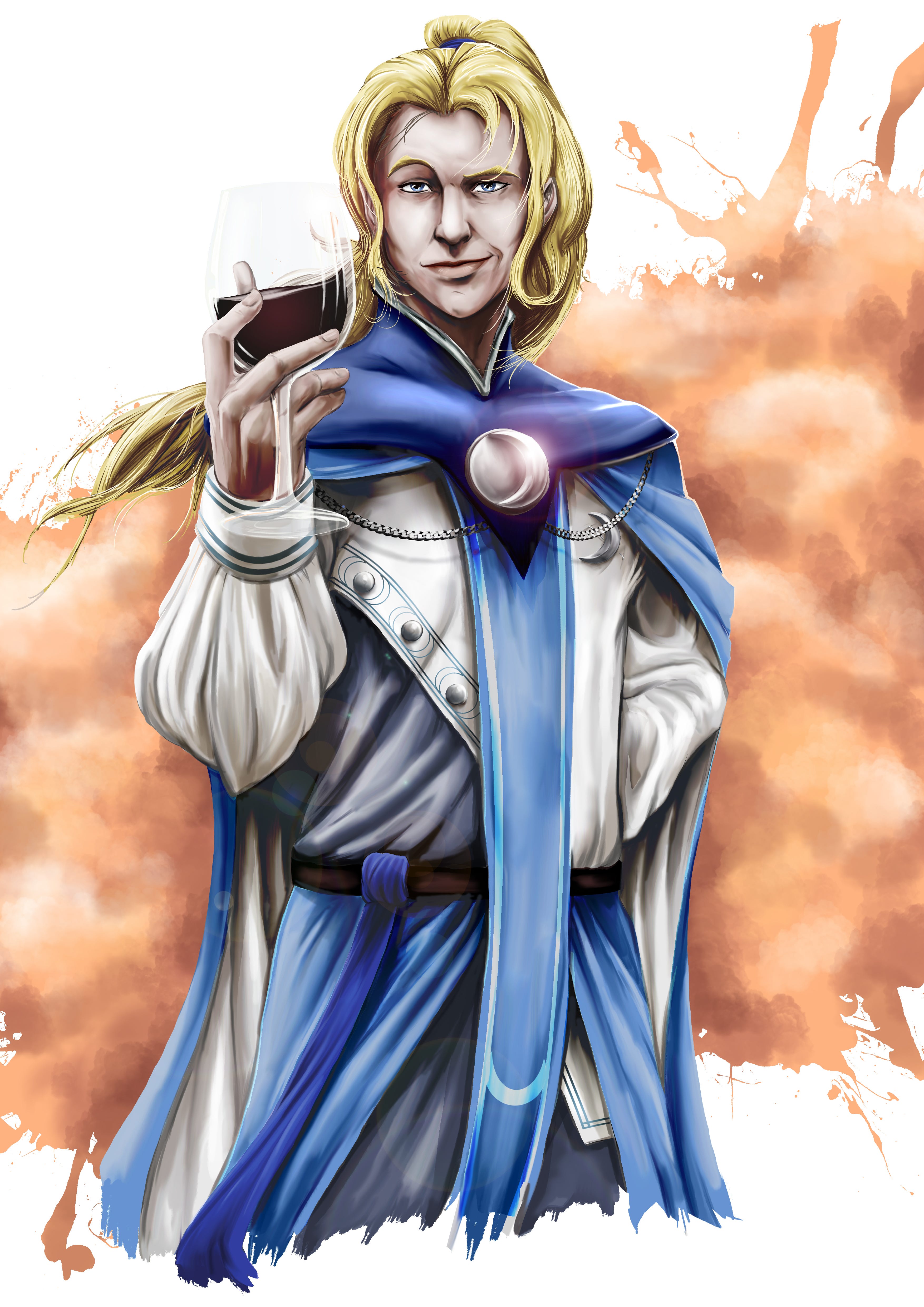
Ah Entonin. I love this picture so much because Chris leaned HARD into Entonin’s attitude, and it is perfect. Yessss.
Entonin is a priest of the Ellathian god of knowledge, Ardulath. He is a Seeker, ostensibly an ambassador and collector of knowledge - though Seekers are largely considered to be spies for the Holy Ellathian Empire by anyone who encounters them. Magic is banned by the Empire, where any who show the gift are hunted down and put to death. So what exactly is this Ellathian priest doing in Amoria, the city of mages?
‘Enjoying the wine’ is what he’d say. I have to admit, Entonin was one of the most fun characters to write in The Outcast Mage. My younger self definitely set out to write the least priestly priest she could think of, and though he’s evolved a good deal since those early days, I’m not going to lie that some of that is still in the heart of this character. He enjoys the finer things in life, is altogether too pleased with himself, and really doesn’t know the meaning of the word humility at all. One of the things I enjoy about him the most is that he provides a really fun outside view of our magical city, and certainly has plenty of opinions about it.
Book Recommendation Time!
And we have more outstanding books to recommend this month, and both of these books are actually out and available NOW (for a change) - so no excuses.
Meet Me In Another Life by Catriona Silvey. ‘This is not a love story. This is a story about love’ reads the tagline for this book, and it couldn’t be more perfect. It’s a gorgeous story set in the beautiful German city of Cologne following Thora and Santi, two characters who can’t escape the feeling that they have met before… It’s hard to tell you too much about this book without spoilers, but it is a beautiful and devastating tale spanning multiple lifetimes. It deals with themes of love and loss, but more than anything what it means to truly know a person, and how none of us can be everything to a person. Silvey explores so many kinds of love, each time with empathy and insight, and she’s utterly unrepentant about breaking your heart. I found myself thinking about these characters long after I finished the last page.
Fathomfolk by Eliza Chan. I have the incredibly beautiful Illumicrate copy of this book, and if you haven’t see it yet, you should absolutely google it, because it is gorgeous. Chan’s description of her book at events is ‘what if the Little Mermaid was a pissed off immigrant’ - and what a pitch. Fathomfolk is a political fantasy featuring a semi-submerged city populated by the watery creatures of myth and legend - sirens, kelpies, kappas and (my personal favourite) sea witches. The story is fast-paced, full of heart and asks all the difficult questions: what is the price of change and is it worth paying? Can you really make a difference from within the system of your oppressors? Or is it better to tear it all down? Check it out for a tale with dragons, East Asian mythology, and some definite vibes reminiscent of Avatar the Last Airbender and Arcane (two of my absolute favourite shows).
And okay, that’s a wrap on July’s newsletter! Thank you so much to all of you for coming along with me on this mad journey! Next month I will likely be in the depths of sleep deprivation and new motherhood, so the next newsletter might be a short one - but stay tuned to hear about events coming up at Glasgow World Con 2024 and more!
This was extremely interesting! Thank you for sharing a bit of the behind-the-scenes stuff of how publishing a book works!